McDewey
/mcpPage 8
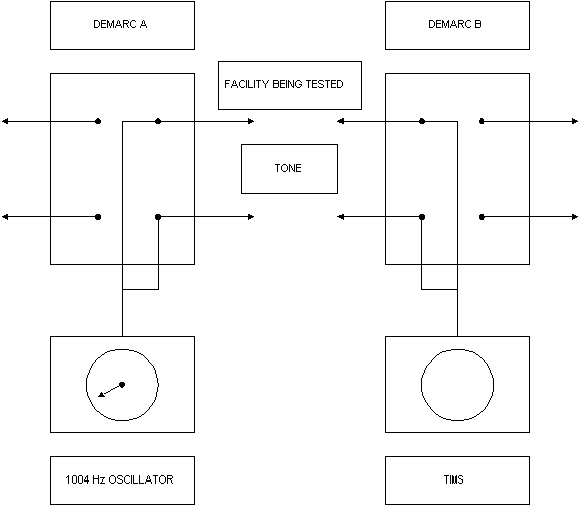
↗ View in doc contextIn a similar manner, power, at specified points in a circuit, can be described in terms of the power at a standard reference point. This point, which is analogous to sea level, is called the zero transmission level point, or 0 TLP. Any other TLP can be referenced to the 0 TLP by algebraically summing the 1004 Hz gains and losses from the 0 TLP to the point of measurement. The power present at a particular point in a circuit depends on the power at the signal source, on where the source is applied, and on the loss or gain between the two points in question. With the use of the 0 TLP concept, the power in a circuit is described by stating what the power would be if it were accurately measured at the 0 TLP. The standard notation is dBm0, which means power referenced to the 0 TLP. For example, the term ™3 dBm0 means that the power at the 0 TLP is ™3 dBm. A TIMS that is properly set up measures ™3 dBm at the 0 TLP. An example of a ™3 dBm0 signal. Once the power at the 0 TLP is found, the power at any other point in the circuit can easily be determined. For example, if the signal is ™3 dBm when measured at the 0 TLP, it is l3 dB below the numeric value of any TLP on the circuit when measured at that TLP. If the signal is ™3 dBm at the 0 TLP (makes it a ™3−dBm0 signal), then the power at the +5 TLP can be calculated as this output shows: (TLP) + (Power at the 0 TLP) = Power at the +5 TLP)