McDewey
/mcpPage 9
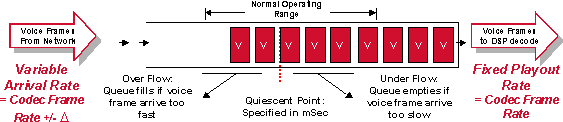
↗ View in doc contextIt is essential to handle properly the de-jitter buffer . If samples are held for too short a time,
variations in delay can potentially cause the buffer to under-run and cause gaps in the speech. If the
sample is held for too long a time, the buffer can overrun, and the dropped packets again cause gaps
in the speech. Lastly, if packets are held for too long a time, the overall delay on the connection can
rise to unacceptable levels.
The optimum initial play out delay for the de-jitter buffer is equal to the total variable delay along
the connection. This is shown in Figure 5-4.
Note: The de-jitter buffers can be adaptive, but the maximum delay is fixed. When adaptive buffers
are configured, the delay becomes a variable figure. However, the maximum delay can be used as a
Page 9 of 18
Cisco - Understanding Delay in Packet Voice Networks
7/31/2008
http://kbase.cisco.com/paws/servlet/ViewFile/5125/delay-details.xml?convertPaths=1