McDewey
/mcpPage 13
↗ View in doc contextNote: Since queuing delay and the variable component of the Network delay is already accounted
within the de-jitter buffer calculations, the Total delay is effectively only the sum of all the Fixed
Delay. In this case the total delay is 209.1 ms.
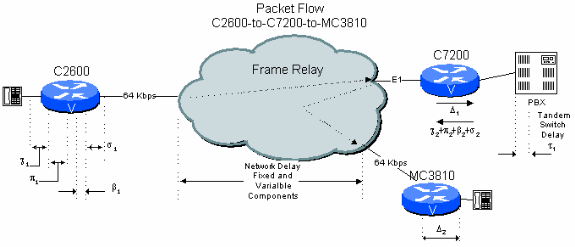
Two-Hop Connection over a Public Network with a PBX Tandem Switch
Figure 6-3: Two Hop Public Network Example with PBX Tandem
Consider a branch-to-branch connection in a branch-to-headquarters network where the C7200 at the
headquarters site passes the connection through to the headquarters PBX for switching. Here the
voice signal has to be decompressed and de-jittered and then re-compressed and de-jittered a second
time. This results in extra delays relative to the previous example. Additionally, the two CS-ACELP
compression cycles reduce voice quality (see Effects Of Multiple Compression Cycles).
Table 6.3: Two Hop Public Network Delay Calculation with PBX Tandem
Delay Type
Fixed
(ms)
Variable
(ms)
Coder Delay, χ1
18
Packetization Delay, π1
30
Queuing/Buffering, ß1
8
Serialization Delay (64 kbps),
σ1
5
Network Delay (Public Frame),
ω1
40
25
De-jitter Buffer Delay, Δ1
40
Coder Delay, χ2
15
Packetization Delay, π2
30
Queuing/Buffering, ß2
0.1 Serialization Delay (2 Mbps), 0.1
Page 13 of 18 Cisco - Understanding Delay in Packet Voice Networks 7/31/2008 http://kbase.cisco.com/paws/servlet/ViewFile/5125/delay-details.xml?convertPaths=1