Document Metadata
Format: PDF
Title: Use SIP Profiles on CUBE Enterprise Common Use Cases
Page 1
Use SIP Profiles on CUBE Enterprise Common
Use Cases
Contents
Introduction
Prerequisites
Requirements
Components Used
Background Information
Common SIP Message Normalization Scenarios
Copy Value from Diversion Header to the From Header
Copy Number from To Header in an Incoming Invite to the REQ-URI Parameter (Prior to Cisco IOS
Version 15.4)
Copy Number from To Header in an Incoming Invite to the REQ-URI Parameter (with Inbound SIP
Profiles)
One-way / No-way Audio Interoperability Issues with Provider
Remove the UPDATE Method Support to Avoid Interoperability Issues
IP Address to Domain Name Conversion
Add a Prefix in the Diversion Header
Set DID Number in Diversion Header
Remove Diversion Header
Copy Location Number for Caller ID in Local Gateway (Webex Calling Deployments in United States,
Canada, and Puerto Rico)
Possible Issues
Related Information
Introduction
This document describes how to use the Session Initiation Protocol (SIP) Profile Test Tool that is available
for use on Cisco.com.
Prerequisites
Requirements
The information in this document is based on ISR platforms running Cisco IOS® and Cisco IOS® XE
software.
Components Used
Cisco recommends that you have knowledge of these topics:
Navigation through Cisco IOS®
•
SIP message format and transactions
•
Page 2
The information in this document was created from the devices in a specific lab environment. All of the
devices used in this document started with a cleared (default) configuration. If your network is live, ensure
that you understand the potential impact of any command.
Background Information
SIP Profiles are used in order to manipulate header information in the SIP messages. They can also be used
to make changes in the Session Description Protocol (SDP), which is used to negotiate media.
Common SIP Message Normalization Scenarios
This section provides several SIP message normalization scenarios that have been seen frequently. Each
scenario includes the configuration required on Cisco IOS for your reference and a screenshot from the SIP
Profile Test Tool that is mentioned in the Introduction.
These scenarios can be used as references for other manipulation required on the SIP messages.
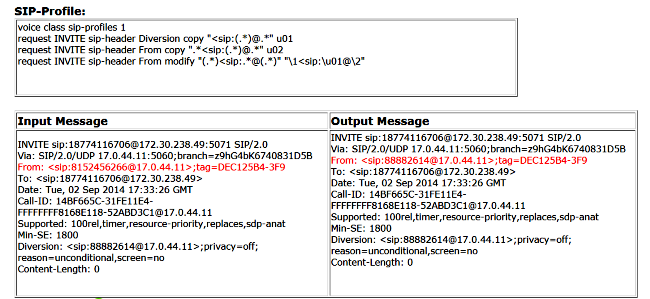
Copy Value from Diversion Header to the From Header
voice class sip-profiles 1
request INVITE sip-header Diversion copy "<sip:(.)@." u01
request INVITE sip-header From copy ".<sip:(.)@.*" u02
request INVITE sip-header From modify "(.)<sip:.@(.*)" "\1<sip:\u01@\2"
request INVITE sip-header From modify "<sip:@" "<sip:\u02@"
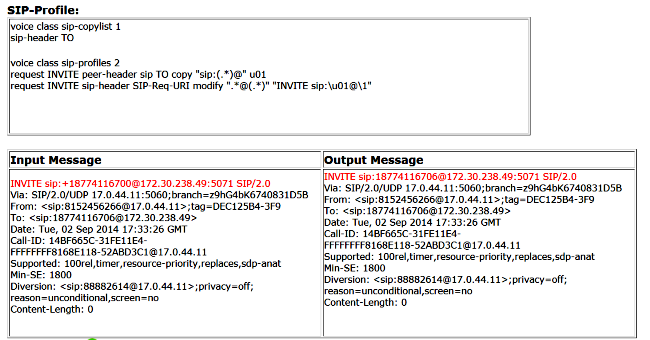
Copy Number from To Header in an Incoming Invite to the REQ-URI Parameter
(Prior to Cisco IOS Version 15.4)
Page 3
Copy the number in the To header in an inbound Invite message and modify the outgoing INVITE:
voice class sip-copylist 1
sip-header TO
voice class sip-profiles 2
request INVITE peer-header sip TO copy "sip:(.)@" u01
request INVITE sip-header SIP-Req-URI modify ".@(.*)" "INVITE sip:\u01@\1"
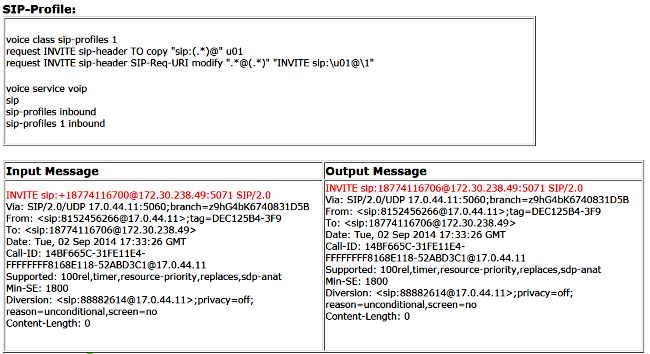
Copy Number from To Header in an Incoming Invite to the REQ-URI Parameter (with
Inbound SIP Profiles)
voice class sip-profiles 1
request INVITE sip-header TO copy "sip:(.)@" u01
request INVITE sip-header SIP-Req-URI modify ".@(.*)" "INVITE sip:\u01@\1"
voice service voip
sip
sip-profiles inbound
sip-profiles 1 inbound
Page 4
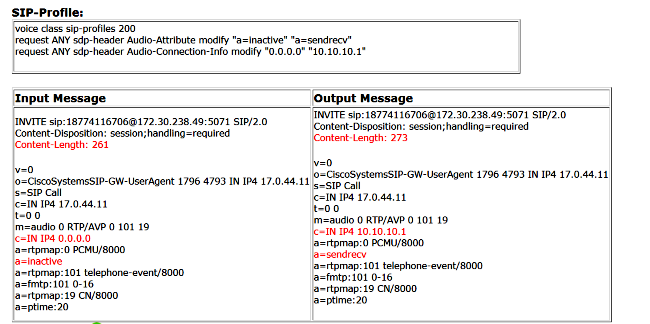
One-way / No-way Audio Interoperability Issues with Provider
voice class sip-profiles 200
request ANY sdp-header Audio-Attribute modify "a=inactive" "a=sendrecv"
request ANY sdp-header Audio-Connection-Info modify "0.0.0.0" "CUBE’s IP"
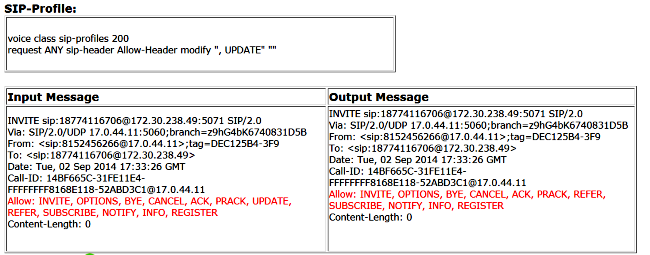
Remove the UPDATE Method Support to Avoid Interoperability Issues
Page 5
voice class sip-profiles 200
request ANY sip-header Allow-Header modify ", UPDATE" ""
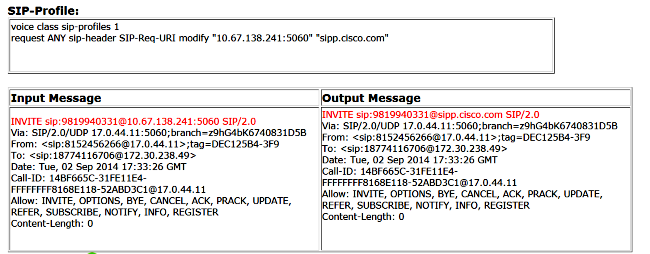
IP Address to Domain Name Conversion
voice class sip-profiles 1
request ANY sip-header SIP-Req-URI modify "10.67.138.241:5060" "sipp.cisco.com"
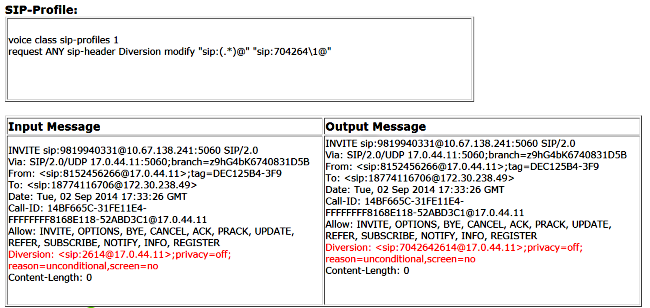
Add a Prefix in the Diversion Header
voice class sip-profiles 1
request ANY sip-header Diversion modify "sip:(.*)@" "sip:704264\1@"
Page 6
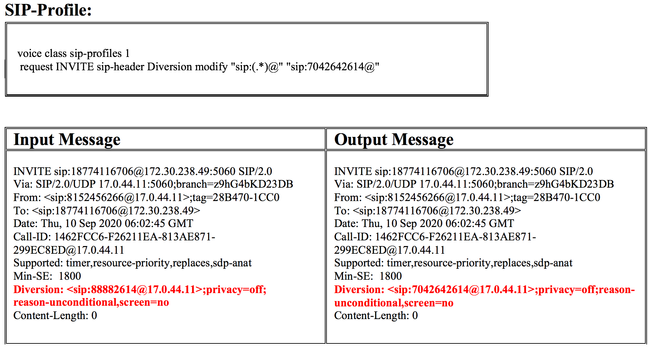
Set DID Number in Diversion Header
voice class sip-profiles 1
request INVITE sip-header Diversion modify "sip:(.*)@" "sip:7042642614@"
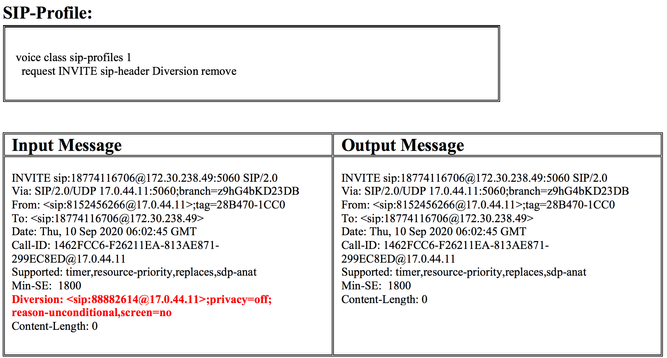
Remove Diversion Header
Page 7
voice class sip-profiles 1
request INVITE sip-header Diversion remove
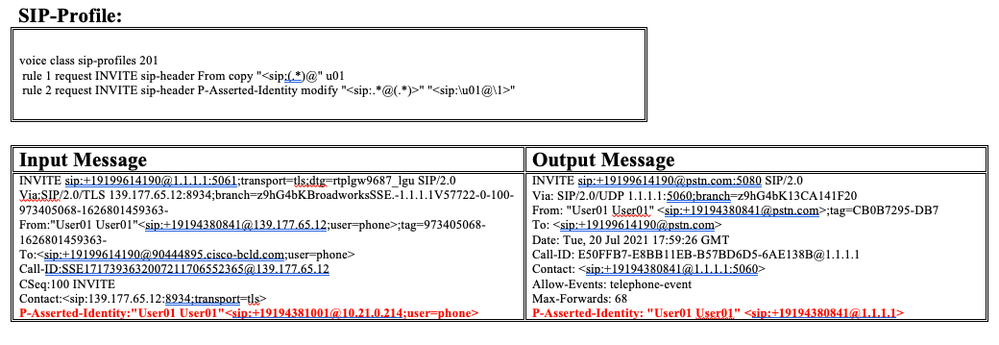
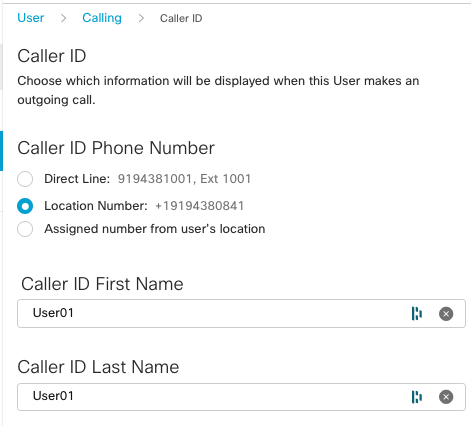
Copy Location Number for Caller ID in Local Gateway (Webex Calling Deployments
in United States, Canada, and Puerto Rico)
Page 8
voice service voip
sip
sip-profile inbound
voice class sip-profiles 201
rule 1 request INVITE sip-header From copy "<sip:(.*)@" u01
rule 2 request INVITE sip-header P-Asserted-Identity modify "sip:.*@(.*)" "sip:\u01@\1"
voice class tenant 200
sip-profiles 201 inbound
Page 9
Possible Issues
Here are some possible issues you can encounter.
After Cisco IOS Version 15.4, the SIP profile feature is introduced to modify inbound SIP messages
as well.
•
Cisco IOS Versions 15.3 and earlier only support SIP profiles in the outbound direction.
•
Related Information
In Depth Explanation of Cisco IOS and IOS-XE Call Routing
Understanding Inbound and Outbound Dial Peers Matching on IOS Platforms