McDewey
/mcpPage 898
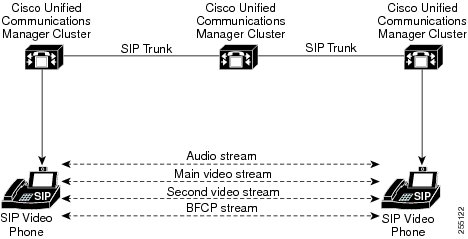
↗ View in doc contextUnified Communications Manager aids in the negotiation of the BFCP stream by relaying SIP messages between two endpoints. This negotiation involves establishing a floor, which is a temporary permission to access shared resources. The BFCP stream is a point-to-point stream between the endpoints. Unified Communications Manager is never a target of the BFCP stream. The following figure provides an example of a complex video network with multiple Unified Communications Manager clusters. BFCP must be enabled on all the trunks and lines connecting the devices. For this network, BFCP must be enabled on the four SIP trunks and two SIP lines that connect the endpoints. Figure 14: Video Network with Multiple Cisco Unified Communications Manager Clusters BFCP Limitations Unified Communications Manager rejects the BFCP stream in the following scenarios: • The Allow Presentation Sharing using BFCP check box on the SIP Profile page is unchecked for one of the SIP lines or trunks in the network. • One endpoint offers BFCP, but the other does not. • When the SIP line or SIP trunk uses MTP (non pass-through mode) or Transcoder. BFCP control channel is always unencrypted. However, the presentation channel is encrypted if both phones are encrypted. Note Presentation Sharing using BFCP Prerequisites • Make sure all endpoints and trunks in the call flow are running SIP profile. • Check Phone Support procedure and generate a report for the feature BFCP Support to obtain a list of Cisco endpoints that support Presentation Sharing using BFCP. For these endpoints, BFCP support is Feature Configuration Guide for Cisco Unified Communications Manager, Release 15 and SUs 856 SIP Interoperability BFCP Limitations