McDewey
/mcpPage 1401
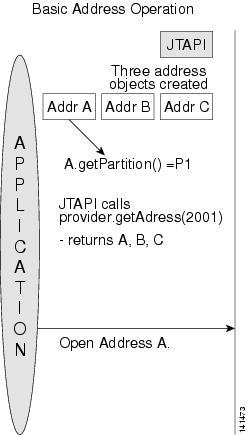
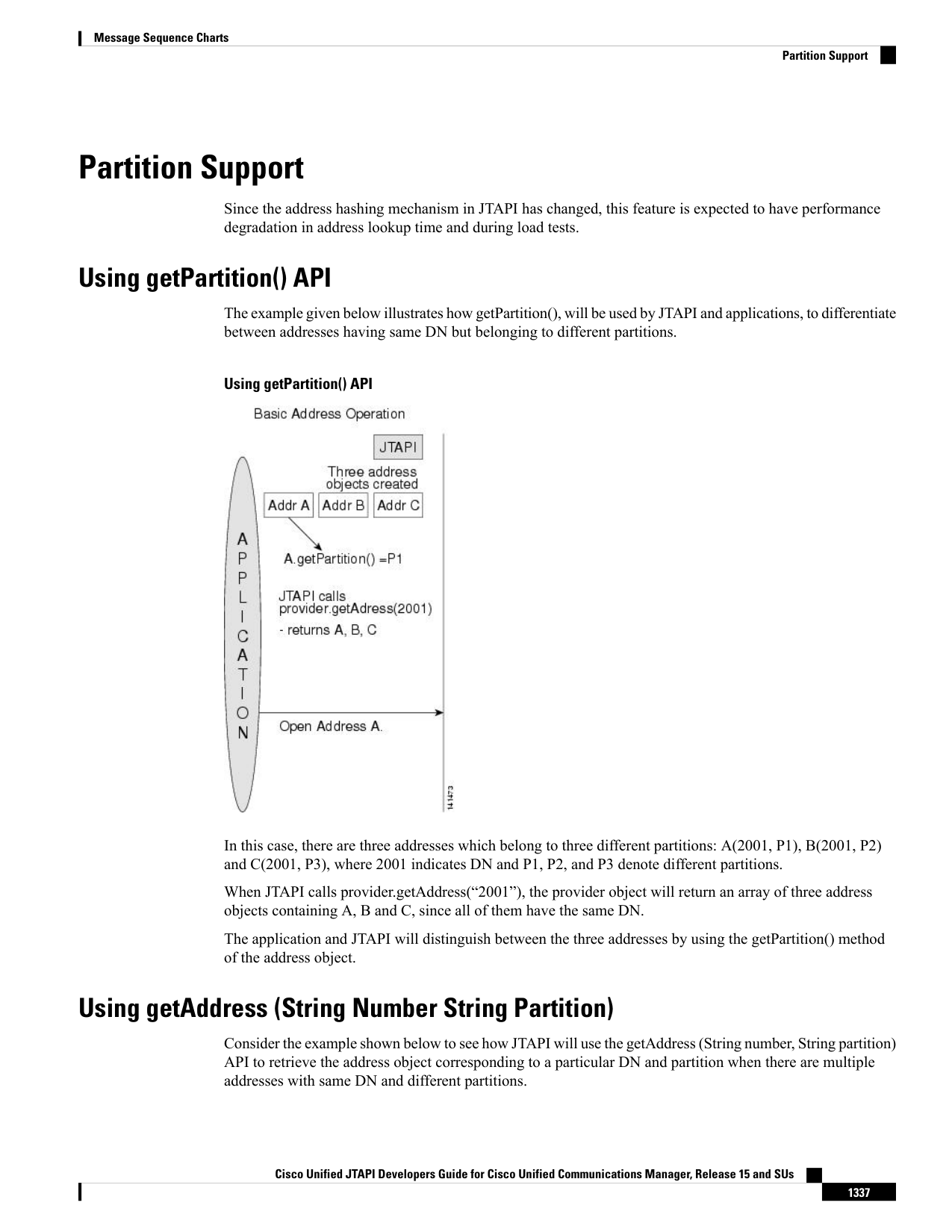
↗ View in doc contextPartition Support Since the address hashing mechanism in JTAPI has changed, this feature is expected to have performance degradation in address lookup time and during load tests. Using getPartition() API The example given below illustrates how getPartition(), will be used by JTAPI and applications, to differentiate between addresses having same DN but belonging to different partitions. Using getPartition() API In this case, there are three addresses which belong to three different partitions: A(2001, P1), B(2001, P2) and C(2001, P3), where 2001 indicates DN and P1, P2, and P3 denote different partitions. When JTAPI calls provider.getAddress(“2001”), the provider object will return an array of three address objects containing A, B and C, since all of them have the same DN. The application and JTAPI will distinguish between the three addresses by using the getPartition() method of the address object. Using getAddress (String Number String Partition) Consider the example shown below to see how JTAPI will use the getAddress (String number, String partition) API to retrieve the address object corresponding to a particular DN and partition when there are multiple addresses with same DN and different partitions. Cisco Unified JTAPI Developers Guide for Cisco Unified Communications Manager, Release 15 and SUs 1337 Message Sequence Charts Partition Support