McDewey
/mcpPage 455
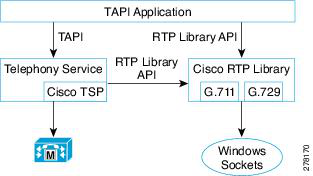
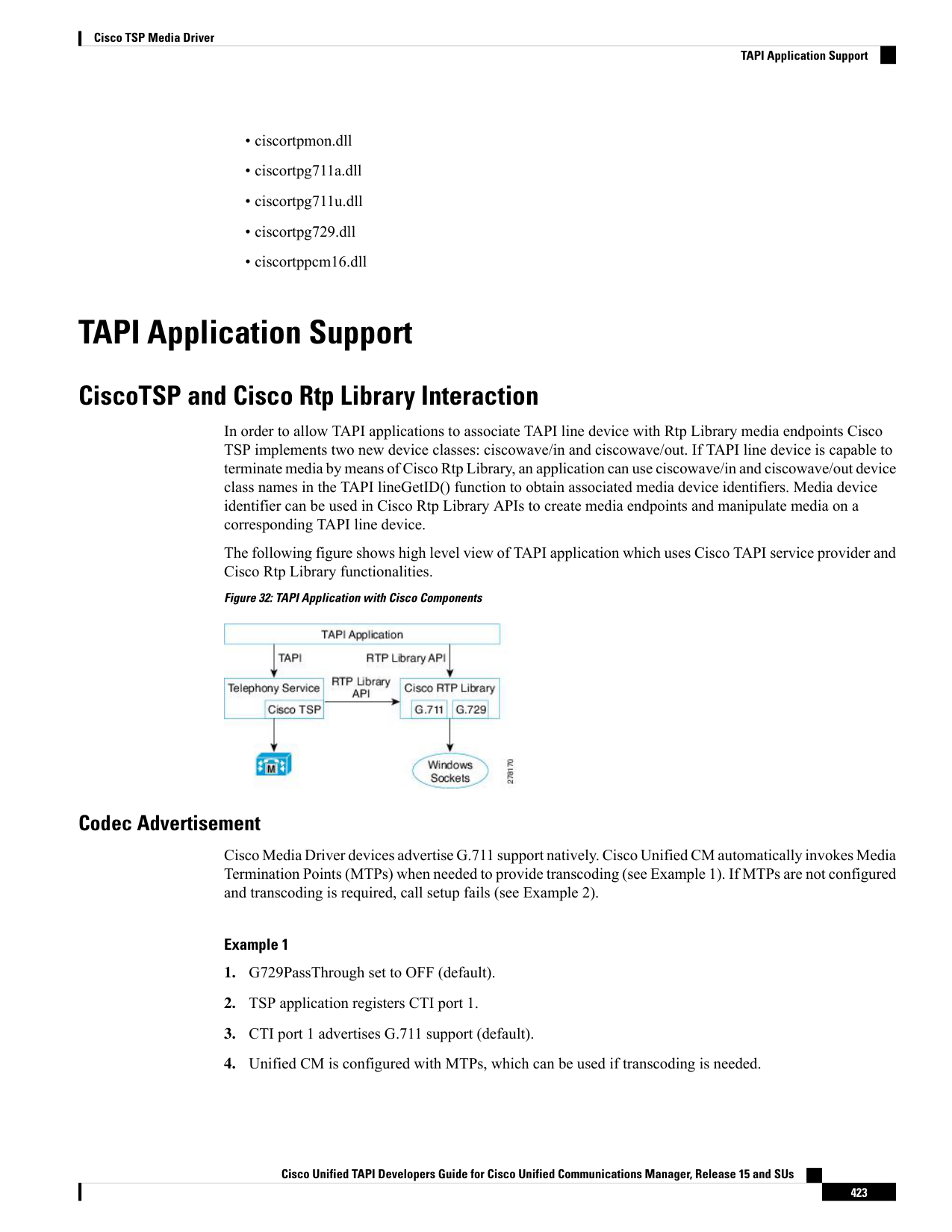
↗ View in doc context• ciscortpmon.dll • ciscortpg711a.dll • ciscortpg711u.dll • ciscortpg729.dll • ciscortppcm16.dll TAPI Application Support CiscoTSP and Cisco Rtp Library Interaction In order to allow TAPI applications to associate TAPI line device with Rtp Library media endpoints Cisco TSP implements two new device classes: ciscowave/in and ciscowave/out. If TAPI line device is capable to terminate media by means of Cisco Rtp Library, an application can use ciscowave/in and ciscowave/out device class names in the TAPI lineGetID() function to obtain associated media device identifiers. Media device identifier can be used in Cisco Rtp Library APIs to create media endpoints and manipulate media on a corresponding TAPI line device. The following figure shows high level view of TAPI application which uses Cisco TAPI service provider and Cisco Rtp Library functionalities. Figure 32: TAPI Application with Cisco Components Codec Advertisement Cisco Media Driver devices advertise G.711 support natively. Cisco Unified CM automatically invokes Media Termination Points (MTPs) when needed to provide transcoding (see Example 1). If MTPs are not configured and transcoding is required, call setup fails (see Example 2). Example 1 1. G729PassThrough set to OFF (default). 2. TSP application registers CTI port 1. 3. CTI port 1 advertises G.711 support (default). 4. Unified CM is configured with MTPs, which can be used if transcoding is needed. Cisco Unified TAPI Developers Guide for Cisco Unified Communications Manager, Release 15 and SUs 423 Cisco TSP Media Driver TAPI Application Support