McDewey
/mcpPage 15
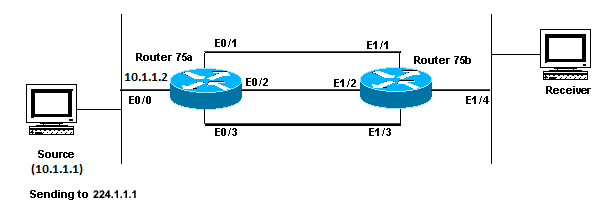
↗ View in doc contextexample. Equal Cost Paths to a Multicast Source Causes Unwanted RPF Behavior Diagnose the Problem In the figure, Router 75b has three equal cost paths back to the Source (10.1.1.1), and it chooses a link that you do not want to be its first choice as the RPF link. When faced with multiple equal cost paths to a source, IP multicast chooses the interface that has a Protocol Independent Multicast (PIM) neighbor with the highest IP address as the incoming interface and then sends prunes to PIM neighbors on the other links. Possible Fixes In order to change the interface IP multicast chooses as its incoming interface, you can do one of these: Only configure PIM on the interfaces that you want multicast to traverse, which means you lose multicast redundancy. • Change the subnets so the highest IP address is on the link you want to be the primary multicast link. • Create a static multicast route (mroute) that points out the preferred multicast interface, which means you lose multicast redundancy. • As an example, a static mroute is created. Before you install a static mroute, you see in this output that the routing table has three equal cost routes for the source address 10.1.1.1. The RPF information indicates that the RPF interface is E1/3:
<#root> ip22-75b# show ip route 10.1.1.1
Routing entry for 10.1.1.1/24 Known via "ospf 1", distance 110, metric 20, type intra area Redistributing via ospf 1 Last update from 10.3.1.1 on Ethernet1/2, 00:26:21 ago