McDewey
/mcpPage 21
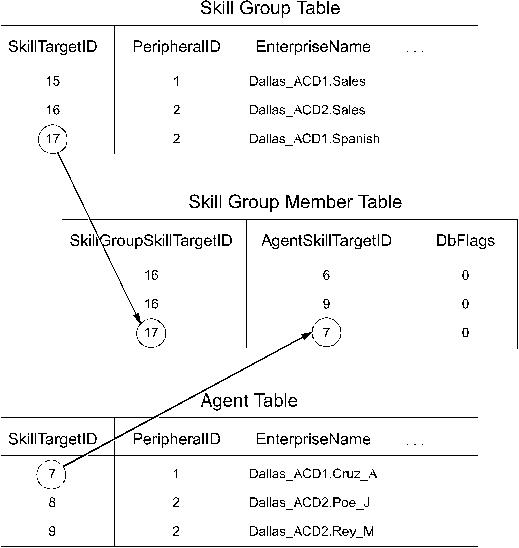
↗ View in doc contextThe Skill Group Member table contains one record for each member of each skill group. It has one-to-many relationships with both the Agent table and the Skill Group table. This avoids a direct many-to-many relationship between the Agent and Skill Group tables. Key Fields One or more fields within a table can form a key. Keys are the fields that you commonly use to locate specific records. Usually the fields that make up a key are defined as NOT NULL (meaning they cannot take the NULL value), but there are many exceptions. Most tables have a primary key. For example, the PeripheralID field is the primary key for the Peripheral table. An example of a foreign key is the PeripheralID field in the Agent table. You can use this key to find all agents that are associated with a specific peripheral. The Agent table contains two alternate keys: the EnterpriseName field, and the combination of the PeripheralID and PeripheralNumber fields. A value for either of these keys uniquely identifies an agent. The combination of FirstName and LastName is an inversion key for the Agent table. While this key value is not necessarily unique, it is a convenient way to locate specific agents. This table lists the types of keys and the codes that are used for them in the system database. Database Schema Handbook for Cisco Unified Contact Center Enterprise, Release 15.0(1) 3 Introduction Key Fields