McDewey
/mcpPage 3
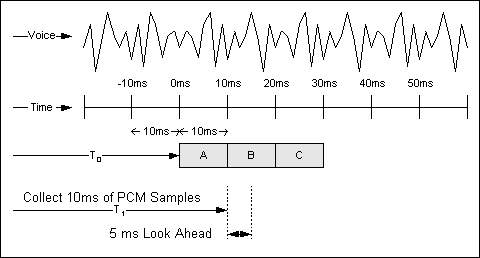
↗ View in doc contextFigure 3-1 Voice Compression
The analog voice stream is digitized into PCM samples and delivered to the compression algorithm
in 10 ms increments. The look ahead is discussed in Algorithmic Delay.
Standards for Delay Limits
The International Telecommunication Union (ITU) considers network delay for voice applications in
Recommendation G.114. This recommendation defines three bands of one-way delay as shown in
Table 4.1.
Table 4.1 Delay Specifications
Note: These recommendations are for connections with echo adequately controlled. This implies that
echo cancellers are used. Echo cancellers are required when one-way delay exceeds 25 ms (G.131).
These recommendations are oriented for national telecom administrations. Therefore, these are more
stringent than when normally applied in private voice networks. When the location and business
needs of end users are well-known to the network designer, more delay can prove acceptable. For
private networks 200 ms of delay is a reasonable goal and 250 ms a limit. All networks need to be
engineered such that the maximum expected voice connection delay is known and minimized.
Sources of Delay
Range in
Milliseconds
Description
0-150
Acceptable for most user applications.
150-400
Acceptable provided that administrators
are aware of the transmission time and
the impact it has on the transmission
quality of user applications.
Above 400
Unacceptable for general network
planning purposes. However, it is
recognized that in some exceptional cases
this limit is exceeded.
Page 3 of 18
Cisco - Understanding Delay in Packet Voice Networks
7/31/2008
http://kbase.cisco.com/paws/servlet/ViewFile/5125/delay-details.xml?convertPaths=1