McDewey
/mcpPage 4
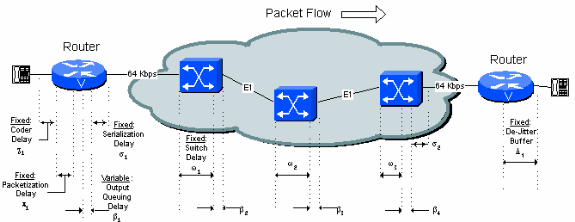
↗ View in doc contextCoder (Processing) Delay
Coder delay is the time taken by the digital signal processor (DSP) to compress a block of PCM
samples. This is also called processing delay (χn). This delay varies with the voice coder used and
processor speed. For example, algebraic code excited linear prediction (ACELP) algorithms analyze
a 10 ms block of PCM samples, and then compress them.
The compression time for a Conjugate Structure Algebraic Code Excited Linear Prediction (CS-
ACELP) process ranges from 2.5 ms to 10 ms based on the loading of the DSP processor. If the DSP
is fully loaded with four voice channels, the Coder delay is 10 ms. If the DSP is loaded with only one
voice channel the Coder delay is 2.5 ms. For design purposes use the worst case time of 10 ms.
Decompression time is roughly ten percent of the compression time for each block. However, the
decompression time is proportional to the number of samples per frame because of the presence of
multiple samples. Consequently, the worst case decompression time for a frame with three samples
is 3 x 1 ms or 3 ms. Usually, two or three blocks of compressed G.729 output are put in one frame
while one sample of compressed G.723.1 output is sent in a single frame.
Best and worst case coder delays are shown in Table 5.1.
Table 5 .1 Best and Worst Case Processing Delay
Coder
Rate
Required
Sample
Best Case
Coder
Worst
Case
Coder
Page 4 of 18
Cisco - Understanding Delay in Packet Voice Networks
7/31/2008
http://kbase.cisco.com/paws/servlet/ViewFile/5125/delay-details.xml?convertPaths=1