McDewey
/mcpPage 5
↗ View in doc contextAlgorithmic Delay
The compression algorithm relies on known voice characteristics to correctly process sample block
N. The algorithm must have some knowledge of what is in block N+1 in order to accurately
reproduce sample block N. This look ahead, which is really an additional delay, is called algorithmic
delay. This effectively increases the length of the compression block.
This happens repeatedly, such that block N+1 looks into block N+2, and so forth and so on. The net
effect is a 5 ms addition to the overall delay on the link. This means that the total time required to
process a block of information is 10 m with a 5 ms constant overhead factor. See Figure 3-1: Voice
Compression.
z Algorithmic Delay for G.726 coders is 0 ms
z Algorithmic Delay for G.729 coders is 5 ms.
z Algorithmic Delay for G.723.1 coders is 7.5 ms
For the examples in the remainder of this document, assume G.729 compression with a 30 ms/30
byte payload. In order to facilitate design, and take a conservative approach, the tables given in the
remainder of this document assume the worst case coder delay. The coder delay, decompression
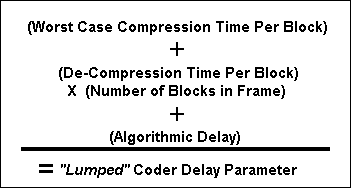
delay, and algorithmic delay is lumped into one factor which is called the coder delay.
The equation used to generate the lumped Coder Delay Parameter is:
Equation 1 : Lumped Coder Delay Parameter
Block
Delay
Delay
ADPCM,
G.726
32
Kbps 10 ms
2.5 ms
10 ms
CS-
ACELP,
G.729A
8.0
Kbps 10 ms
2.5 ms
10 ms
MP-MLQ,
G.723.1
6.3
Kbps 30 ms
5 ms
20 ms
MP-
ACELP,
G.723.1
5.3
Kbps 30 ms
5 ms
20 ms
Page 5 of 18
Cisco - Understanding Delay in Packet Voice Networks
7/31/2008
http://kbase.cisco.com/paws/servlet/ViewFile/5125/delay-details.xml?convertPaths=1